The road
The Appian Way, explained
Rome's oldest long road: who built it, what lines it, what UNESCO recognised and why a gladiator show sits beside it.
Book the gladiator show ↗Quick answer
The Appian Way, or Via Appia, is a Roman road that Wikipedia says Appius Claudius Caecus began in 312 BC and that ran from Rome to Brindisi. UNESCO inscribed it in July 2024. Its Rome stretch lies within the Appian Way Regional Park, which holds catacombs, tombs and aqueducts, and is home to the Gruppo Storico Romano's headquarters.
A road named for its builder
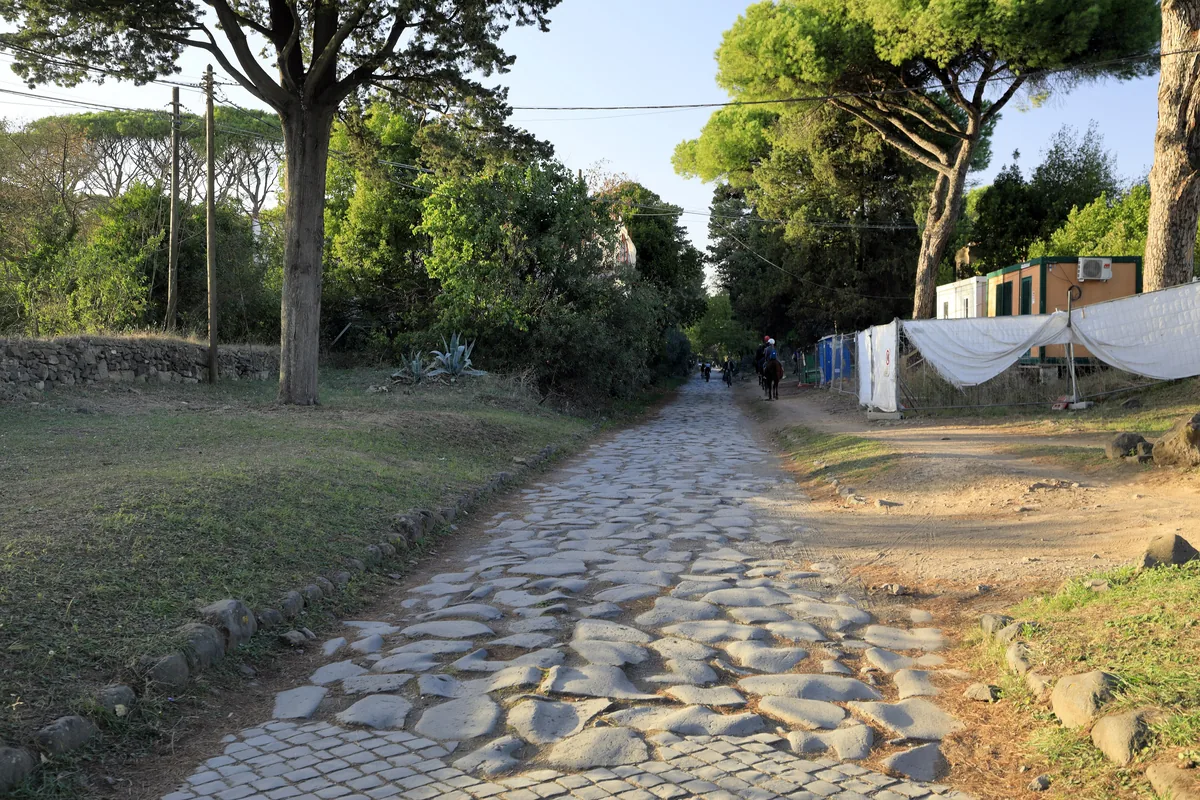
Wikipedia says Appius Claudius Caecus, a Roman censor, began the road in 312 BC, and that the Rome to Brindisi route reached about 540 km, or 335.5 miles. It describes the original Roman section as surviving, with monuments from many periods along it, and says the cement has eroded from the joints and left a rough surface. The poet Statius, the article says, called it the queen of the long roads, and UNESCO's listing uses the name Via Appia, Regina Viarum.
What lines it
Near the part of the road closest to Rome, Wikipedia says, lie three catacombs of Roman and early Christian origin and one of Jewish origin. It also names the Tomb of Caecilia Metella and the Circus of Maxentius among the monuments in the first four miles. The article notes that in 71 BC, after the revolt of Spartacus, about 6,000 captured slaves were crucified along roughly 200 km of the road between Rome and Capua, a fact that appears in the history of the road and in the story of the gladiator Spartacus.
The regional park
Wikipedia says the Appian Way Regional Park was established in 1988 and covers about 4,580 hectares. It holds stretches of the road, Roman aqueducts, villas, mausoleums and catacombs, and names the Villa of the Quintilii and the Caffarella Valley among its sites. The article says the park lies mainly within Rome and runs along the road from the centre of the city to about the tenth mile. The Gruppo Storico Romano's headquarters at Via Appia Antica 18 lies on this road.
The UNESCO listing
Wikipedia says the road was inscribed in July 2024, under the reference number 1708, under criteria iii, iv and vi, under the name Via Appia, Regina Viarum. It is a recent distinction, and visitors who read older guidebooks may not find it mentioned. The inscription does not change how you visit, but it explains why the road appears in more itineraries now.
The road today
Wikipedia says the first five kilometres carry heavy car, bus and coach traffic, and that beyond that traffic is light and the ruins can be explored on foot. It adds that the GRA ring road cut the Appian Way in two in 1951, and a later tunnel reconnected it, so about 16 km can be walked from near the Baths of Caracalla. It also says the old road near Rome is a free tourist attraction. Check the park's current arrangements before you go.
Other sights along the road
If you have a free morning, Wikipedia names several sites in the park and along the road. They include the Tomb of Caecilia Metella and the Circus of Maxentius within the first four miles, the Villa of the Quintilii, the Caffarella Valley, the Villa dei Sette Bassi and the Aqueducts Park. The catacombs lie near the end of the road closest to Rome. None of these is part of the gladiator show ticket, so book anything you want separately and check each site's own arrangements.
Why a gladiator show sits here
The association's headquarters is on the road, and its museum displays arms and armour, as Turismo Roma says, reproduced from research. The booking page calls the site the headquarters of the gladiators and puts it about 3.5 km from the Colosseum. For visitors, the appeal is a different Rome: a historic road on the edge of the city where an evening can include a museum, a performance and the old paving outside.
Frequently asked questions
Who built the Appian Way?
Wikipedia says Appius Claudius Caecus, a Roman censor, began it in 312 BC.
Is it a UNESCO World Heritage Site?
Wikipedia says it was inscribed in July 2024 as Via Appia, Regina Viarum.
Is the road open to cars?
Wikipedia says the first five kilometres carry heavy traffic, with light traffic beyond. Check the park's current arrangements before you visit.
Sources